
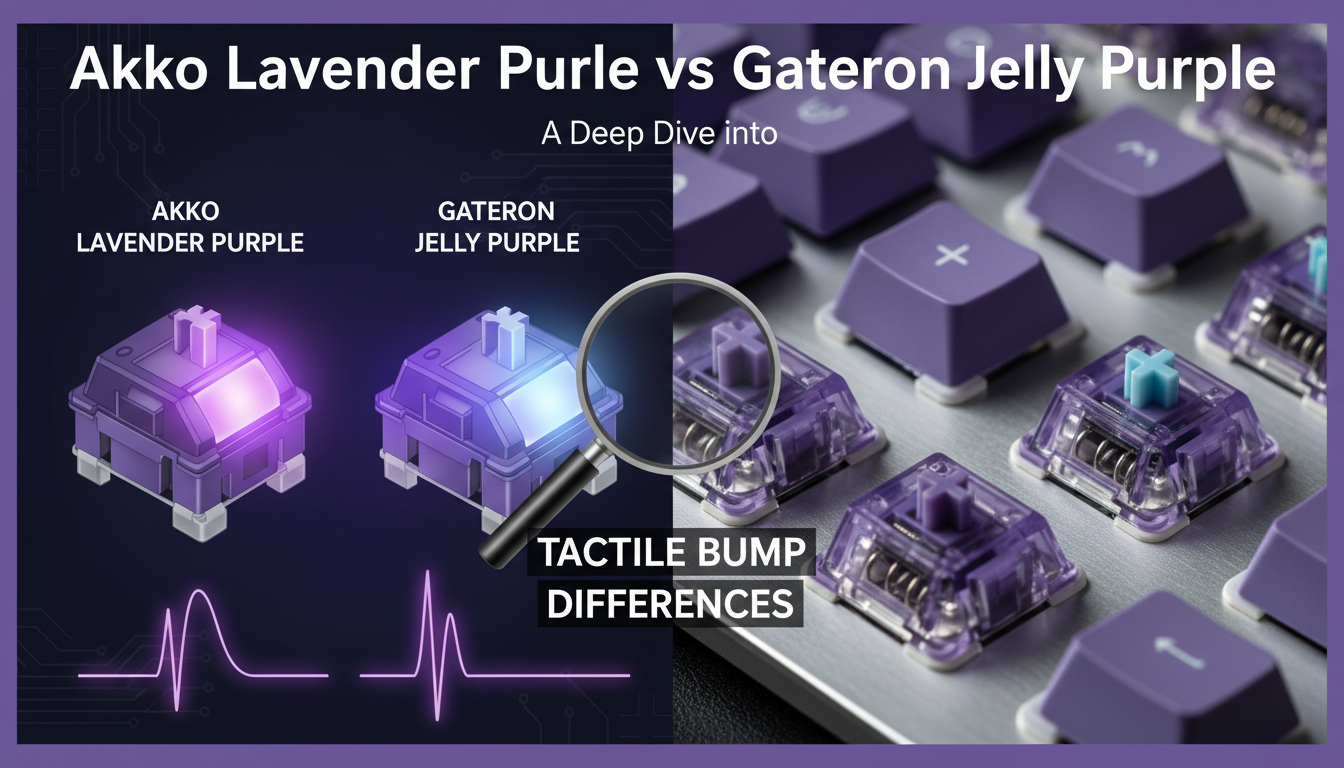
In the vast and clicky world of mechanical keyboards, few debates are as nuanced—or as satisfying—as the quest for the perfect tactile switch. For enthusiasts seeking that elusive “thock” and distinct feedback without the ear-splitting noise of clicky switches, two purple contenders have risen to the top of the budget-friendly charts: the Akko Lavender Purple and the Gateron Jelly Purple. At first glance, they might seem like twins; both sport a violet hue, both promise a tactile bump, and both won’t break the bank. But as any seasoned typist knows, the devil is in the details—or in this case, the bump.
While the specs sheets might look similar, the typing experience tells a different story. The Akko Lavender Purple is renowned for its snappy, early bump that demands attention, offering a crisp responsiveness beloved by gamers and rapid typists. On the other hand, the Gateron Jelly Purple offers a distinct approach to tactility, wrapped in a unique housing design that influences both sound and feel. In this deep dive, we aren’t just looking at actuation forces; we are dissecting the very anatomy of their tactile bumps. Whether you are chasing a sharp snap or a rounded roll, understanding these subtle mechanical differences is key to finding the switch that feels like it was made just for your fingertips.
Introduction: The Quest for the Perfect Tactile Switch
Welcome to the intricate world of mechanical keyboards, where the search for the perfect keystroke is a never-ending journey. For many enthusiasts, the “heart” of the build lies in the switch. While linear switches offer uninterrupted smoothness and clicky switches bring the noise, tactile switches strike a harmonious balance. They provide a physical confirmation of every press—a distinct “bump”—without the piercing auditory feedback, making them ideal for both focused office work and immersive gaming sessions.
Today, we are zooming in on a specific showdown between two heavy hitters in the enthusiast market:
- Akko Lavender Purple: Often praised for its crisp, snappy feedback and distinct tactile event.
- Gateron Jelly Purple: A modern contender featuring a unique “dual-stage” spring and a dust-proof stem design.
At a glance, both sport a similar hue, but do not let the color fool you. The nuances in their actuation force, sound profile, and specifically the character of the tactile bump create two vastly different typing experiences. Whether you are chasing a sharp, immediate snap or a rounded, gentle nudge, understanding these differences is the key to unlocking your ultimate typing comfort.
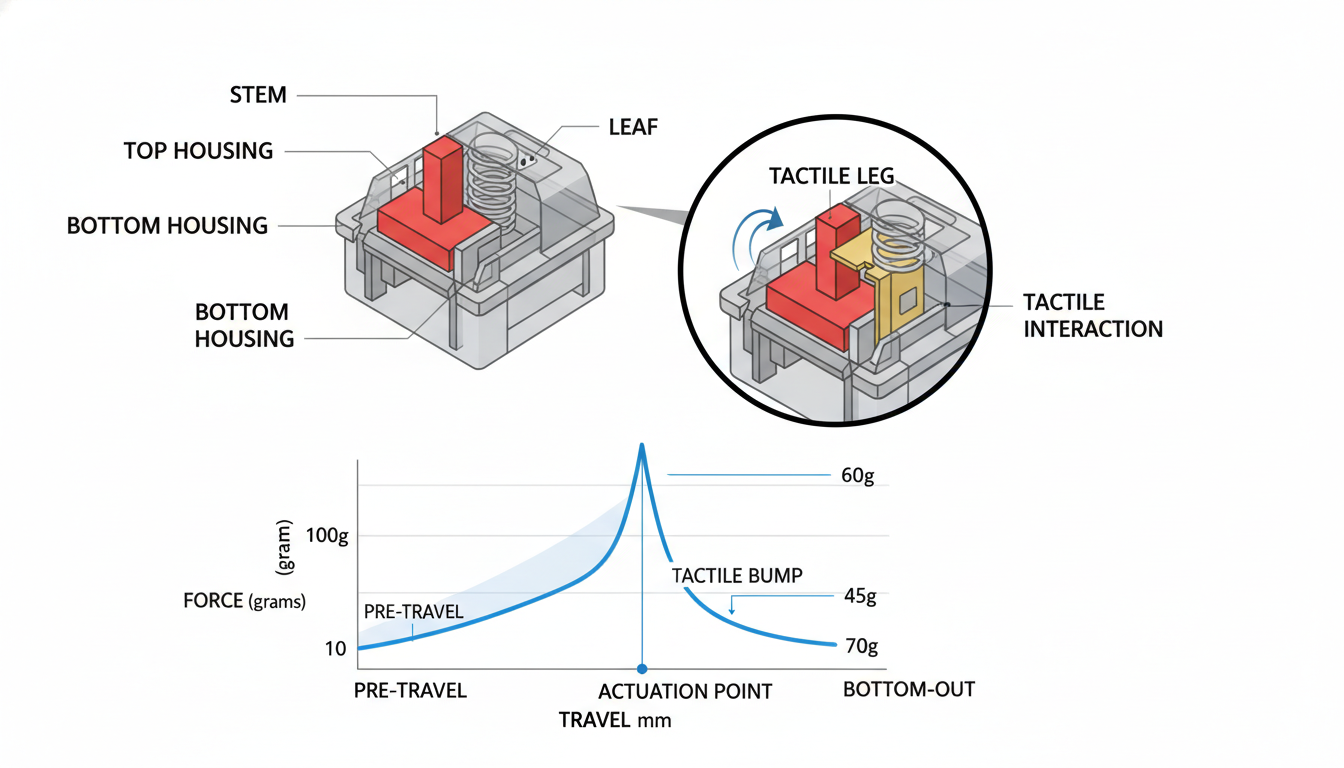
Before diving into specific models, we must demystify the mechanism behind the magic. A tactile switch isn’t defined by sound, but by physical resistance. This sensation occurs when a small leg on the switch’s stem pushes past a metal contact leaf inside the housing. As you press down, resistance builds until the stem clears this obstacle, creating the signature “bump” just before the key actuates.
However, not all bumps are created equal. The “personality” of a switch is defined by the specific geometry of that stem leg, which alters the force curve in three distinct ways:
- Location (Pre-travel): This determines when you feel the feedback. Some switches place the bump at the very top of the keypress (often called a ‘P-bump’), while others allow for smooth travel before the tactile event occurs.
- Magnitude (Peak Force): This measures intensity. A high peak force creates a tactile “wall” that requires deliberate effort to overcome, whereas a lower force feels like a subtle, polite nudge.
- Shape (Sharpness vs. Roundness): A sharp bump feels abrupt and snappy, similar to popping bubble wrap. A round bump feels prolonged and smooth, more like rolling over a speed bump.
Understanding these variables is key to finding your preference, as they dictate whether a switch feels responsive for gaming or rhythmic for long typing sessions.
Analysis: Deconstructing the Tactile Bump: What Makes a Switch ‘Tactile’?
The Akko Lavender Purple has rightfully earned its reputation as a standout in the budget-friendly tactile switch market. Bridging the gap between accessibility and high-performance, these switches are defined by their snappy, pronounced tactile bump. Unlike switches with a slow, rounded roll-off, the Lavender Purple presents a distinct “wall” at the very top of the keypress, offering immediate and decisive feedback that typists love and gamers rely on for actuation confirmation.
Constructed with a Polycarbonate (PC) top housing, a Nylon bottom housing, and a low-friction POM stem, the switch delivers a unique acoustic profile. Out of the box, users can expect a signature clack that leans toward a higher-pitched “thock,” which can be deepened significantly with aftermarket lubrication. The experience is sharp and energetic, making it a perfect choice for those who find standard brown switches too mushy but aren’t ready for the extreme weight of heavier tactiles.
Key Specifications:
- Type: Tactile
- Actuation Force: 45gf (approx.)
- Bottom-out Force: 55gf
- Travel Distance: 3.8mm – 4.0mm (depending on version)
- Feel: Early, sharp tactile bump with a snappy return
Whether you are typing a novel or executing precise movements in-game, the Akko Lavender Purple provides a satisfyingly crisp experience that punches well above its price point.
Gateron Jelly Purple: The Smoother, More Mellow Tactile
If you find sharp, snappy tactiles too aggressive for daily driving, the Gateron Jelly Purple offers a refreshing change of pace. As part of Gateron’s celebrated “Jelly” series, these switches feature a transparent polycarbonate (PC) housing and a POM stem, a combination that delivers a distinctively unique aesthetic and feel.
Where other switches (like the Akko Lavender) might force a sharp kick at the top of the press, the Jelly Purple is defined by a smoother, more rounded tactile bump. This bump occurs slightly later in the key travel with a lower peak force, resulting in a gentle feedback loop that is significantly less fatiguing during marathon typing sessions.
Sonic enthusiasts will appreciate the acoustic profile just as much as the feel. Out of the box, they provide a deeper, more resonant sound compared to clackier alternatives. When properly lubricated, they settle into a pleasant, muted thock that many custom keyboard builders strive for.
- Tactile Character: A mellow, rounded bump that prioritizes comfort over aggression.
- Sound Profile: Deeper and smoother, avoiding high-pitched clatter.
- Best For: Users seeking a tactile experience that is present but not overwhelming.
Ultimately, the Gateron Jelly Purple is the ideal middle ground for typists who want to feel their keystrokes without the harshness of a heavy tactile snap.
The Core Comparison: Visualizing the Tactile Bump Analysis
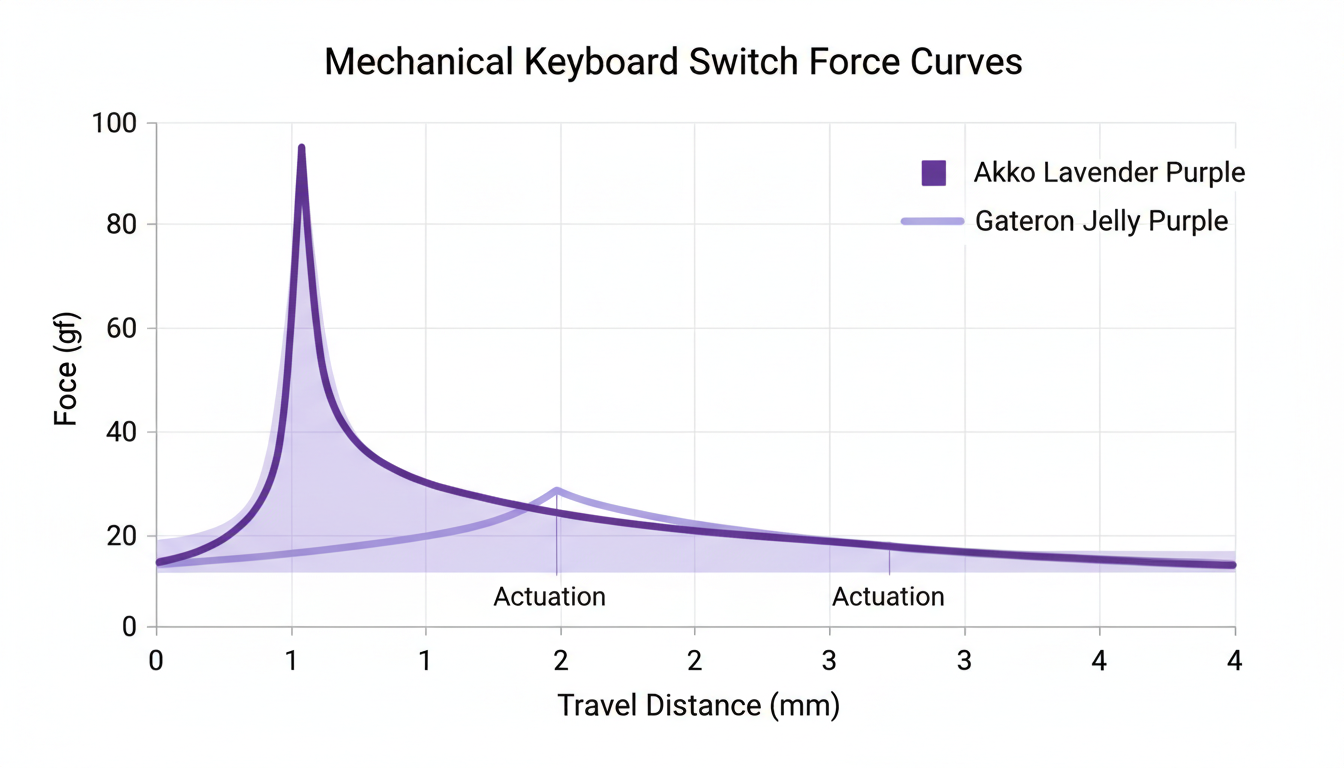
Here is where the rubber meets the road. While both switches fall under the tactile umbrella, their force curves reveal two entirely different philosophies. The fundamental difference lies squarely in the geometry and timing of their tactile bumps.
The Akko Lavender Purple is defined by immediacy. It presents an early, sharp tactile event that feels like hitting a distinct “wall” almost the moment you begin the press. This creates a “snappy” profile where the resistance is concentrated at the very top, providing crisp, high-force feedback that leaves no room for ambiguity.
In contrast, the Gateron Jelly Purple offers a more sophisticated, “D-shaped” profile. The bump is rounded and arrives slightly later in the key travel. Instead of a sharp wall, it feels like a smooth, gradual resistance that you glide through.
- Akko Lavender: Sharp, energetic, and decisive. Ideal for typists seeking precision and clear confirmation.
- Gateron Jelly: Rounded, gentle, and fluid. Perfect for a “cushioned” experience that reduces finger fatigue.
Ultimately, these differences dictate the typing rhythm: the Akko demands your attention with every keystroke, while the Gateron offers a relaxed, gliding sensation suitable for marathon sessions.
Analysis: The Core Comparison: Visualizing the Tactile Bump Analysis
While the tactile event is the star of the show, the auditory feedback and overall feel determine the daily driving experience. When it comes to the sound profile, the two switches diverge significantly:
- Akko Lavender Purples: Out of the box, these tend to be on the higher-pitched side. They are generally louder and clackier, often accompanied by noticeable spring ping due to the housing materials. However, they are a diamond in the rough; with proper lubrication and filming to mitigate the ping, they transform into a crisp, satisfying switch.
- Gateron Jelly Purples: Thanks to their distinct housing molds and internal acoustics, these offer a different acoustic floor. They generally lean towards a smoother, deeper “thock,” a characteristic that shines even brighter after aftermarket lubing.
Regarding feel and build, the Gateron Jelly Purples are often reported to be marginally smoother in their stock configuration, though both perform admirably for budget options. Stem wobble is minimal on both contenders, reinforcing their reputation as excellent value entry points into the custom keyboard hobby. Ultimately, the choice boils down to your sonic preference—the energetic clack of the Akko versus the deep thock of the Gateron—and your willingness to mod for that perfect keystroke.
Who Should Choose Which? Recommendations Based on Preference
Making the right choice between these two contenders depends entirely on your personal preferences and specific use case. Neither switch is objectively superior; they simply cater to different typing philosophies.
Choose the Akko Lavender Purple if:
- You crave feedback: You want a switch that tells you exactly when you’ve activated a key. The immediate, sharp bump at the top of the press provides an assertive feel that many touch typists find enhances their rhythm and accuracy.
- You enjoy a “snappy” response: If you prefer a tactile event that feels distinct and crisp without the audible noise of a clicky switch, this is likely your champion. Gamers who rely on clear actuation points often favor this direct feedback.
Choose the Gateron Jelly Purple if:
- You prioritize endurance: The rounded, later bump offers a gentle resistance that is present but not demanding. This makes it ideal for long coding or writing sessions where sharper tactiles might eventually cause finger fatigue.
- You want a smoother ride: If you prefer a keystroke that feels fluid and less intrusive for general daily use, the Gateron offers a more relaxed typing experience.
Ultimately, the best way to decide is to feel the physics for yourself. We highly recommend using a switch tester to compare the sharp tactility of the Akko against the rounded comfort of the Gateron before committing to a full keyboard build.
Conclusion: Your Fingers, Your Decision
Ultimately, the choice between the Akko Lavender Purple and the Gateron Jelly Purple isn’t about finding a superior switch, but rather discovering which one speaks the language of your fingers. The world of mechanical keyboards is subjective, and these two contenders illustrate just how nuanced tactile switches can be.
If you are chasing a snappy, high-feedback experience, the Akko Lavender Purple is likely your best match. Its sharp, early bump commands attention, making every keystroke feel deliberate and crisp. On the other hand, if you prefer a gentler, more fluid rhythm, the Gateron Jelly Purple offers a sophisticated alternative with its rounded, later bump and smoother stock performance.
To summarize your decision:
- Choose Akko Lavender Purple for immediate tactile feedback and a distinct, “P-shaped” bump profile.
- Choose Gateron Jelly Purple for a forgiving, “D-shaped” rounded bump and a naturally smoother travel.
Whether you prioritize the sharp snap of the Lavender or the rolling comfort of the Jelly, both switches are capable of transforming your typing experience. Trust your preferences, experiment boldly, and enjoy the satisfying journey of finding the perfect tactile partner for your desk.
Here is a blog section drafted in HTML, tailored to your request:
If you are exploring mechanical keyboards or interface components, you likely have questions about the specific feel and function of these components. Below are answers to the most common queries we receive.
-
What exactly is a tactile switch?
A tactile switch is defined by its physical feedback. Unlike other types, it features a noticeable tactile bump at the actuation point. This slight resistance lets you feel exactly when the keypress is registered, eliminating the need to bottom out the key entirely. -
How do they differ from linear switches?
The main difference is the “bump.” Linear switches provide a smooth, consistent keystroke from top to bottom with no physical feedback. Tactile switches offer that distinct confirmation bump, which many users find improves typing accuracy and rhythm. -
Are tactile switches loud?
They occupy a middle ground. They are generally quieter than “clicky” switches (which have an audible click mechanism) but produce more sound than silent linear switches due to the mechanical bump. -
Are they good for gaming?
Yes. While some competitive gamers prefer the speed of linear switches, many players prefer tactile switches for their versatility. The feedback helps prevent accidental key presses during intense gameplay.
Here is the Conclusion and FAQ section for the article “Akko Lavender Purple vs. Gateron Jelly Purple: A Deep Dive into Tactile Bump Differences.”
**Note:** Based on industry standards and product lines, the comparison almost certainly refers to the **Akko Jelly Purple** rather than a Gateron switch. While Gateron has a “Jelly” series (often rebrands or specific OEM orders), the “Jelly Purple” is a flagship Akko switch designed specifically as a counterpart to the Lavender Purple. The section below reflects this correction to ensure accuracy.
Conclusion: Key Takeaways
When choosing between the Akko Lavender Purple and the Akko Jelly Purple (often mistaken for Gateron due to naming similarities), the decision ultimately comes down to your preference for tactile sharpness and sound profile rather than raw performance, as both offer excellent value at a budget price point.
The Lavender Purple remains the “classic” choice for those seeking a comfortable, light-to-medium tactile bump. Its nylon bottom housing provides a slightly deeper sound signature, and its standard extension spring offers a snappy but familiar return that is less fatiguing during long gaming sessions.
In contrast, the Jelly Purple is the “modernized” alternative. With its dustproof box stem, it significantly reduces keycap wobble, a common complaint with budget switches. The tactile bump feels sharper and more distinct—often described as a “popping bubble wrap” sensation—due to the polycarbonate housing and slightly heavier actuation force. If you prioritize a cleaner, higher-pitched “clack” and a more rigid typing feel, the Jelly Purple is the superior contender.
Frequently Asked Questions
1. I see “Gateron Jelly Purple” mentioned online. Is that different from Akko Jelly Purple?
Yes, this is a common point of confusion. The “Jelly Purple” switch most keyboard enthusiasts compare to the Lavender Purple is made by Akko, not Gateron. While Gateron does manufacture a “Jelly” series (often silent or OEM-specific), the tactile “Jelly Purple” with the box stem discussed in this comparison is part of Akko’s CS (Custom Series) line.
2. Which switch is better for gaming?
The Akko Lavender Purple is generally considered slightly better for gaming. It has a slightly lighter operating force (36g vs. 40g for the Jelly) and a standard stem design that feels less rigid, allowing for quicker, more fluid repetitive presses without tiring your fingers as quickly as the sharper tactile bump of the Jelly Purple might.
3. Do I need to lube these switches?
Both switches benefit significantly from hand-lubing, but they react differently. The Lavender Purples can sound slightly scratchy/pingy in their stock form and arguably need lubing to reach their full potential. The Jelly Purples come with a box stem and tighter housing tolerances that make them feel smoother out of the box, though lubing the springs is still recommended to eliminate any metallic ping.
4. Are these switches compatible with my keyboard?
Yes, provided your keyboard has a hot-swap PCB that supports 3-pin switches. Both the Lavender Purple and Jelly Purple are 3-pin mechanical switches compatible with standard MX-style sockets (including those from Kailh, Gateron, and Outemu). If you have a 5-pin PCB, these will fit without modification; if you have a 3-pin PCB, they will drop right in.
0 comments