
It’s a frustrating moment every mechanical keyboard enthusiast knows too well: you reach for that sleek aluminum knob on your Epomaker TH80 to crank up your favorite track, and… nothing happens. You twist it left, you twist it right, but the volume bar stays frozen.
Suddenly, the premium tactile experience you paid for feels like a glitchy hassle. Is it a hardware failure? Did a driver update break it? Or is your keyboard just stuck in some obscure “menu mode” that the manual barely explains?
Don’t panic—your knob likely isn’t broken. This issue is a common headache for TH80 users, often caused by hidden mode toggles or software conflicts rather than physical damage. In this guide, we’ll walk you through the simple shortcuts and software tweaks needed to get your volume control back in seconds, so you can stop troubleshooting and get back to your flow.
Introduction: The Frustration of a Silent Knob
There is a unique satisfaction in the tactile click of a mechanical switch, but modern enthusiasts know that the rotary knob is often the unsung hero of a productivity setup. The Epomaker TH80 has earned its spot on desks worldwide, blending a compact 75% layout with hot-swappable freedom. However, that premium experience hits a wall when you reach for the dial to adjust your audio, only to be met with… nothing. A non-responsive knob turns a convenient feature into a major annoyance, breaking your workflow and leaving you wondering if your hardware is defective.
You are not alone in this frustration. Whether it arises right out of the box or develops after a firmware update, a silent volume knob is a solvable grievance. This guide is designed to eliminate the guesswork, systematically walking you through the diagnostic process. We will cover:
- Software Configurations: Checking Epomaker driver settings and Windows/Mac compatibility.
- Connection Protocols: Ensuring 2.4GHz, Bluetooth, or wired modes aren’t causing conflicts.
- Hardware Solutions: Inspecting the rotary encoder for physical faults.
Don’t reach for the return label just yet. Let’s troubleshoot the issue and get your effortless audio control back online.
Here is the blog section formatted as requested.
Understanding the Epomaker TH80 Knob’s Core Functionality
Before diving into fixes, it’s crucial to understand how the Epomaker TH80’s knob is designed to operate. At its heart, the knob is a digital rotary encoder, a component that converts physical rotation and clicks into electronic signals. Unlike an analog potentiometer found on older audio equipment, this digital encoder sends discrete “steps” to the keyboard’s onboard controller.
The knob’s behavior is governed by three main layers of interaction:
- Firmware Logic: The keyboard’s internal firmware acts as the translator. It interprets a clockwise turn as “Volume Up” and a counter-clockwise turn as “Volume Down.” If the firmware is outdated or corrupted, it may fail to register these “steps” correctly, causing jumps or unresponsiveness.
- Connection Modes: Whether you are using Wired USB-C, 2.4GHz Wireless, or Bluetooth 5.0, the knob sends standard HID (Human Interface Device) multimedia commands. However, in wireless modes, aggressive battery-saving protocols can sometimes cause a slight “wake-up” delay before the first volume adjustment registers.
- OS Integration: Finally, your operating system (Windows/macOS) receives these commands just like standard keystrokes. The knob does not control the audio hardware directly; instead, it triggers the OS’s native system volume mixer. This means if your OS creates a mismatch between the default playback device and the system volume, the knob may appear to stop working even if the hardware is fine.
Initial Checks & Quick Software Fixes
Before diving into complex repairs, start with the most common troubleshooting steps. Many “broken” media knobs are simply the result of a temporary software glitch or connection issue. Begin by rebooting your computer and re-plugging the keyboard. If you are using a wired connection, try swapping to a different USB port to rule out a faulty port.
Next, verify your operating system’s sound settings to ensure the keyboard is controlling the correct device:
- Windows: Right-click the speaker icon in your taskbar and select “Open Volume mixer”. Ensure your main speakers or headphones are set as the “Default Device” and that the volume slider isn’t muted or locked by another application.
- macOS: Go to System Settings > Sound > Output. Confirm that the correct output device is selected. You can also hold Option + Volume Up to quickly access these settings.
Finally, check for software conflicts. Background applications like Discord or Spotify can sometimes “hijack” media keys. Try closing these apps to see if functionality returns. If issues persist, perform a factory reset on your TH80 by holding FN + ESC for 3-5 seconds until the backlight flashes. Always ensure your computer’s audio drivers are fully updated to avoid compatibility issues.
Deep Dive: Firmware & Software Configuration for Your TH80
The Epomaker TH80’s versatile knob relies entirely on the correct software ecosystem. Identifying your specific model is the critical first step, as the TH80 Pro V2 supports VIA/QMK, while the Standard, SE, and X variants use the proprietary Epomaker Driver.
Mapping the Knob
To map ‘Play/Pause’ to the knob press on non-VIA boards:
- Connect via Cable: Ensure the keyboard is in Wired Mode (Fn + 5). wireless updates often fail.
- Open Epomaker Driver: Locate the visual representation of the knob.
- Select the Function: Click the center “bubble” on the knob graphic. Navigate to the Multimedia tab and select Play/Pause.
- Save: Click ‘Apply’ to flash the new keymap to the board’s onboard memory.
Firmware Flashing & Pitfalls
Firmware updates can fix bugs but carry high risks. Always verify your Product ID on the back label before downloading. Flashing the wrong firmware (e.g., loading “Pro” firmware onto a “Standard” TH80) will likely brick your device. Common post-update glitches, such as a stuck green battery LED, can often be resolved by holding Fn + Esc for 3 seconds to factory reset.
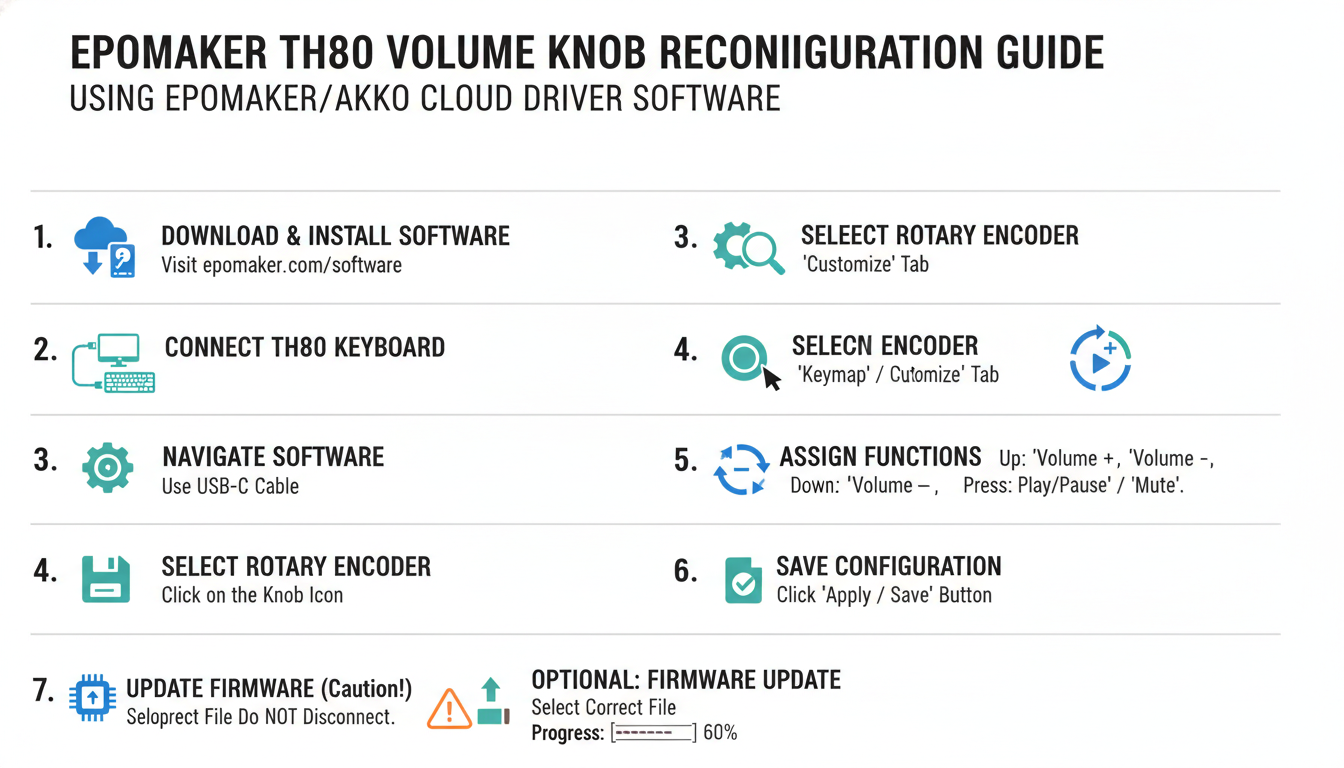
Analysis: Deep Dive: Firmware & Software Configuration for Your TH80
Hardware Inspection & Physical Troubleshooting
If updating firmware and remapping keys hasn’t resolved the issue, the culprit may be mechanical rather than digital. Before assuming the component is dead, perform a thorough physical inspection to rule out common physical obstructions.
Start by testing the knob’s stability. Does it wobble excessively, or does it feel “gritty” when turned? A lack of smooth tactile feedback often indicates foreign objects are trapped inside. To clean the mechanism:
- Remove the Knob Cap: firmly pull the cap straight up. If it is resistant, use a wire keycap puller or a microfiber cloth to get a better grip without scratching the surface.
- Clear Debris: Inspect the underlying rotary encoder for hair, dust, or crumbs. Use compressed air to blast out the encoder well.
- Deep Cleaning: If the rotation feels sticky, dampen a cotton swab with 90%+ isopropyl alcohol and carefully clean around the encoder shaft. Let it dry completely before testing.
For Advanced Users: If the hardware still fails, the issue may be internal. You might consider opening the case to check for loose PCB connections or cracked solder joints connecting the encoder to the board. Warning: Disassembling your keyboard will likely void your warranty. If you suspect a defect and are still within the warranty period, contact the manufacturer before unscrewing the chassis.
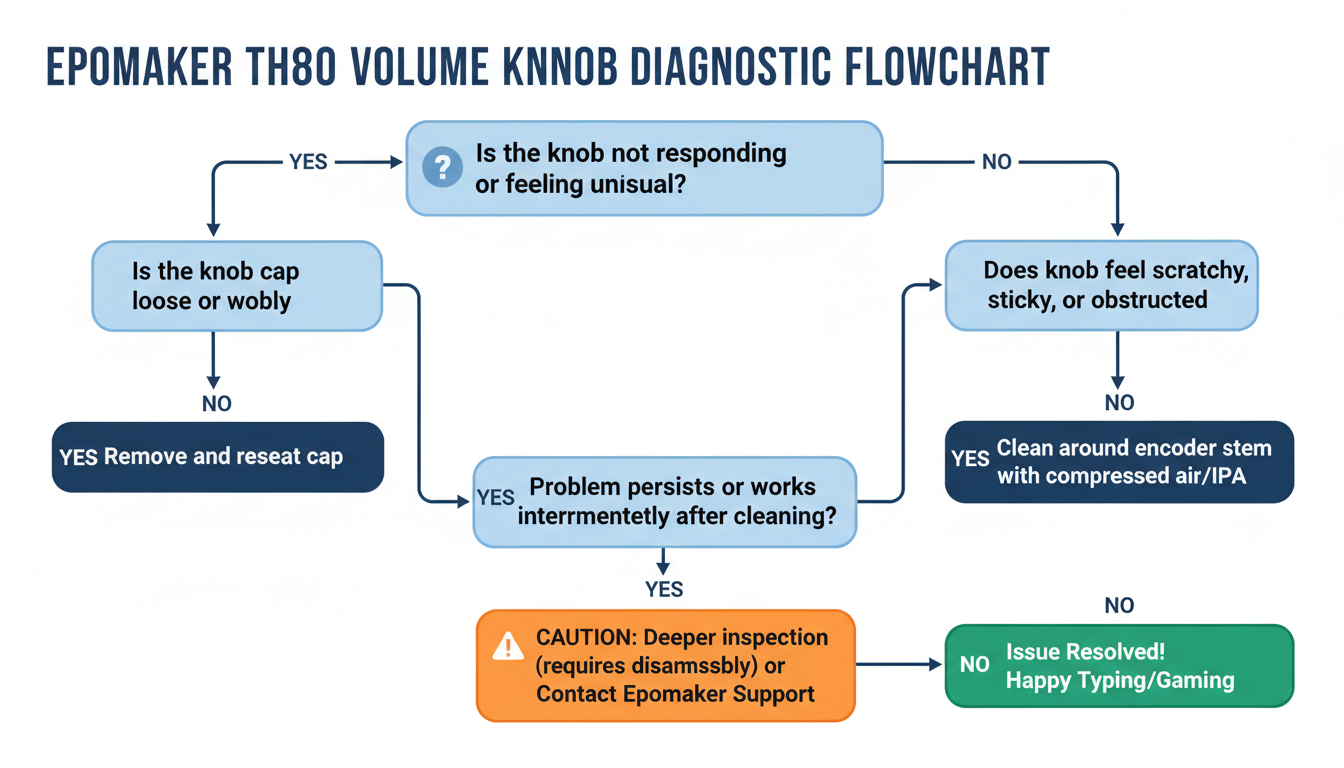
Analysis: Hardware Inspection & Physical Troubleshooting
Operating System Specific Considerations & Conflicts
Even if your TH80 hardware is functioning perfectly, your operating system acts as the gatekeeper for how volume signals are interpreted. Unique behaviors in Windows, macOS, and Linux can often make the knob appear unresponsive when it is actually a software interpretation issue.
- Windows: If the knob is unresponsive, navigate to Device Manager. Check under “Human Interface Devices” or “Keyboards” for any warning icons. A corrupted driver can often be resolved by right-clicking the device, selecting “Uninstall device,” and rebooting to force a fresh install. Be aware that background applications with “global hotkeys” enabled can sometimes hijack these media inputs.
- macOS: Issues here often stem from system preference conflicts. Check System Settings > Sound to ensure the correct output device is targeted. Furthermore, third-party utilities like Karabiner-Elements or specialized audio interface drivers can intercept media commands, preventing the system from adjusting the global volume.
- Linux: The problem may lie within the audio subsystem configuration. Use tools like
xevto verify the input is being received, then check your ALSA or PulseAudio/PipeWire settings. In some distributions, missing kernel modules or improper mapping in the desktop environment can prevent the rotary encoder’s HID codes from triggering the master volume.
By systematically ruling out these OS-level misconfigurations, you can ensure that no background software is silently blocking your keyboard’s input.
Advanced Troubleshooting & Seeking Community Support
If standard fixes haven’t revived your rotary encoder, it is time to isolate the issue definitively. Test your TH80 on a completely different computer. This eliminates potential conflicts with your primary machine’s drivers or registry. For the tech-savvy, booting into a live USB Linux environment (like Ubuntu) is an excellent diagnostic tool; if the knob fails there, you are almost certainly facing a hardware defect rather than a software glitch.
When hardware failure seems likely, your best next step is Epomaker’s official support. Send a detailed email to [email protected] including:
- Your order number and proof of purchase.
- A short video clearly demonstrating the knob’s malfunction.
- A list of troubleshooting steps you have already attempted.
For immediate peer-to-peer advice, the mechanical keyboard community is an invaluable resource. Subreddits like r/MechanicalKeyboards and the unofficial r/Epomaker are active hubs where users often share specific firmware files or workarounds. Additionally, the Epomaker Discord server has dedicated channels where community managers and power users interact daily.
Note for DIY Enthusiasts: While replacing the rotary encoder yourself involves soldering and is a viable fix for experts, be aware that opening the chassis and modifying components will void your 1-year warranty. Proceed with this advanced repair only if you are comfortable with the risk.
Conclusion: Regaining Control of Your Audio
A non-functional volume knob on your Epomaker TH80 is more than just a minor annoyance; it disrupts the seamless workflow and tactile satisfaction that mechanical keyboards are meant to provide. By systematically working through the troubleshooting steps outlined in this guide, you have significantly increased your chances of restoring your keyboard’s full functionality.
We have covered the full spectrum of potential fixes, ensuring no stone was left unturned. To recap, the path to a solution usually involves:
- Software Reconfiguration: Verifying the Epomaker driver settings and key mapping profiles.
- System Checks: Ensuring your OS isn’t overriding HID commands or suffering from driver conflicts.
- Firmware Updates: Flashing the latest version to patch specific bugs related to the rotary encoder.
- Hardware Inspection: checking for physical debris or loose connections.
If you are still facing issues after exhausting these options, do not hesitate to reach out to Epomaker support for a warranty claim or engage with the mechanical keyboard community for specific advice. Remember, patience is key when dealing with technical quirks. We hope this guide has helped you diagnose the problem, allowing you to finally enjoy the intuitive audio control your TH80 was designed to deliver.
FAQ: Your Epomaker TH80 Knob Questions Answered
The aluminum rotary knob is a standout feature of the Epomaker TH80, but its functionality can sometimes be misunderstood. Here are the answers to the most common questions.
What does the knob do by default?
Out of the box, the knob is pre-programmed for media control:
- Rotate Clockwise: Increase system volume.
- Rotate Counter-Clockwise: Decrease system volume.
- Press Down: Mute or unmute audio.
Can I remap the knob functions?
Yes. You can customize the knob using the proprietary Epomaker driver software. In the software interface, you can reassign the rotation and click actions to perform different tasks, such as scrolling pages, adjusting screen brightness, or triggering complex macros.
Help! My knob stopped working. What should I do?
If your knob becomes unresponsive, try these troubleshooting steps:
- Check the Mode: Ensure you haven’t accidentally switched layers or modes (e.g., Mac vs. Windows mode) that might have different mappings.
- Clean the Component: Dust can interfere with the encoder. Remove the knob cap and use compressed air to clean the stem area.
- Factory Reset: Use the shortcut Fn + Esc (hold for 3 seconds) to reset the keyboard to default settings.
Conclusion
If your Epomaker TH80 knob is not working for volume control, the issue is rarely a permanent hardware failure. In most cases, it stems from a software conflict, an accidental mode switch, or a driver mapping error. By following the troubleshooting steps—starting with a simple Factory Reset (FN + ESC) and checking the Epomaker Driver software to ensure the knob is correctly mapped—you can often restore full functionality within minutes.
Remember to verify that your keyboard is set to the correct operating system mode (Windows or Mac) and that no background applications are hijacking the volume input. If the “press-to-mute” function works but the rotation does not, and a factory reset fails to fix it, you may be facing a hardware defect with the rotary encoder itself, which would require a warranty claim.
Frequently Asked Questions
1. How do I factory reset my Epomaker TH80?
To factory reset the TH80, press and hold FN + ESC for about 3 to 5 seconds. The keyboard backlight will flash (usually red or white) to indicate that the reset is complete. This restores the default knob settings and lighting effects.
2. Why does clicking the knob mute the audio, but turning it does nothing?
This specific symptom often indicates that the knob’s function has been unmapped in the driver software or that the “Rotary Encoder” component is physically dirty or damaged. First, open the Epomaker software to ensure “Volume Up” and “Volume Down” are assigned to the knob’s rotation. If the software settings are correct, try blowing compressed air into the crevice of the knob to clear out dust.
3. Can I customize what the knob does on the Epomaker TH80?
Yes, you can customize the knob’s function using the Epomaker Driver Software. You can remap the clockwise and counter-clockwise rotation to perform other actions, such as scrolling, changing RGB brightness, or executing macros, instead of adjusting the volume.
4. Does the knob work differently in Mac Mode vs. Windows Mode?
The volume function should work in both modes, but the system shortcuts differ. Ensure your keyboard is in the correct mode for your computer: press FN + A for Windows mode or FN + S for Mac mode. Being in the wrong mode can sometimes cause multimedia keys (including the knob) to behave unpredictably.
5. What is the difference between the TH80 and TH80-X knob functions?
On the TH80-X (which has a built-in screen), the knob has two modes: Multimedia Mode (volume) and Menu Mode (controlling the screen). You can toggle between these modes by pressing FN + Knob. The standard TH80 and TH80 Pro generally do not have this toggle and are dedicated to volume/mute unless changed via software.
0 comments